Artificial Intelligence and Copyright Law in India: Who Owns AI-Generated Works?
1. Introduction: AI and the Future of Creativity
Artificial Intelligence (AI) has evolved from a futuristic concept into an active participant in the global creative economy. From writing code and composing music to generating hyper-realistic images and assisting in film production, AI’s footprint is everywhere.
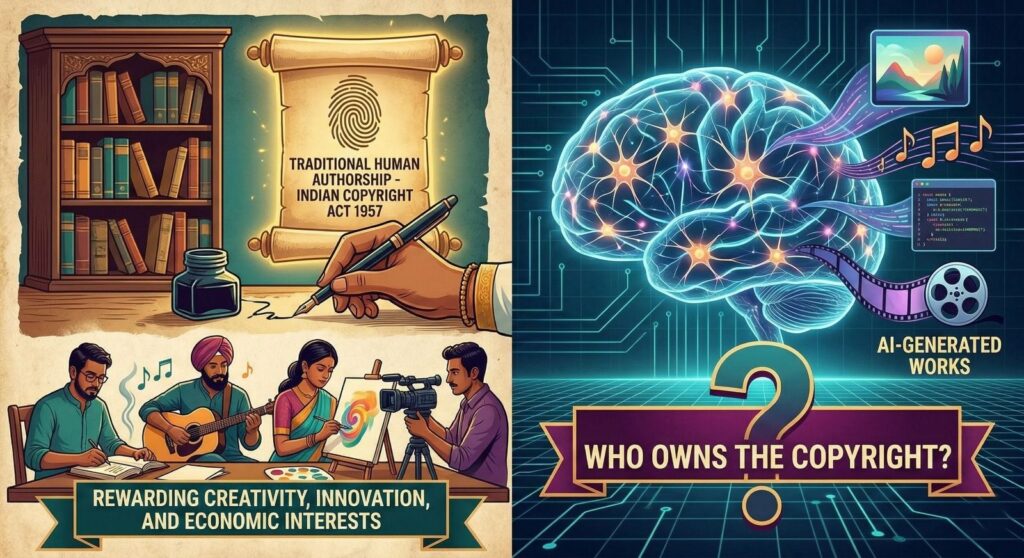
However, this technological leap raises a critical legal question: If an AI creates a work, who owns the copyright?
The Indian Copyright Act of 1957 was designed long before generative AI existed. Today, the legal framework faces a massive challenge: balancing the recognition of AI-assisted creativity with the traditional goal of rewarding human innovation. This blog breaks down the current legal landscape for AI and copyright in India.
2. The Foundation: Human Authorship in Indian Law
In India, copyright protection applies to literary, dramatic, musical, artistic works, and cinematograph films. Under Section 2(d) of the Copyright Act, the “author” is generally the person who creates the work.
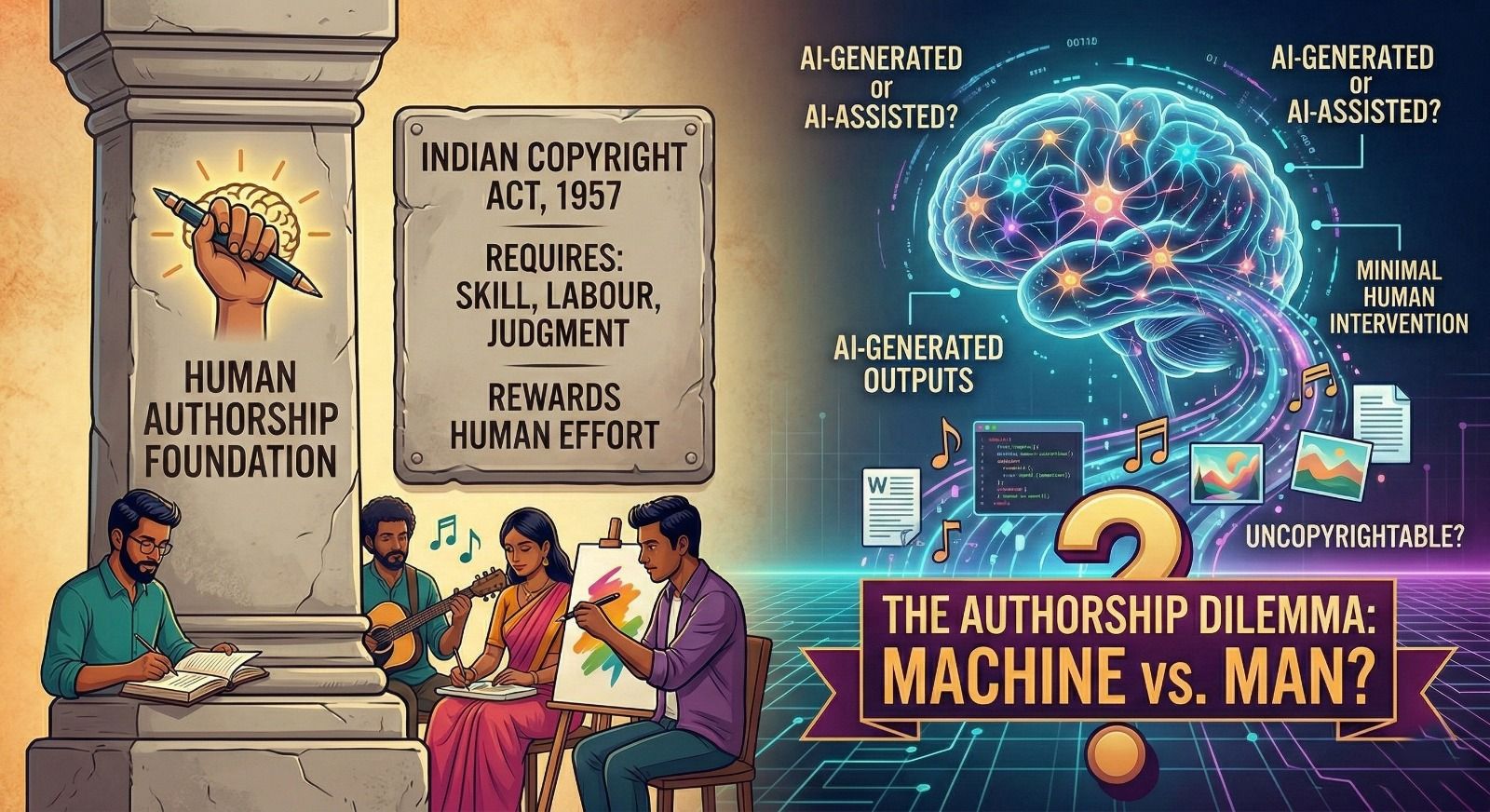
Historically, this system rests on three pillars:
- Skill: The talent applied to the task.
- Labour: The effort expended.
- Judgment: The creative choices made by a human mind.
Because AI disrupts the idea of “human effort,” legal experts are debating whether machine-generated outputs can even qualify for protection under the current statutes.
3. The Authorship Dilemma: Tool vs. Creator
AI-generated content typically falls into two categories that determine its legal standing:
- AI as a Tool: A human provides detailed prompts, refines the output, and exercises significant creative control. In this case, copyright usually belongs to the human user.
- Autonomous AI Output: The AI generates a work with minimal human intervention (e.g., a “one-word” prompt resulting in a complex painting). Here, identifying a human author who meets the “originality” test is difficult.
4. Current Legal Standing in India
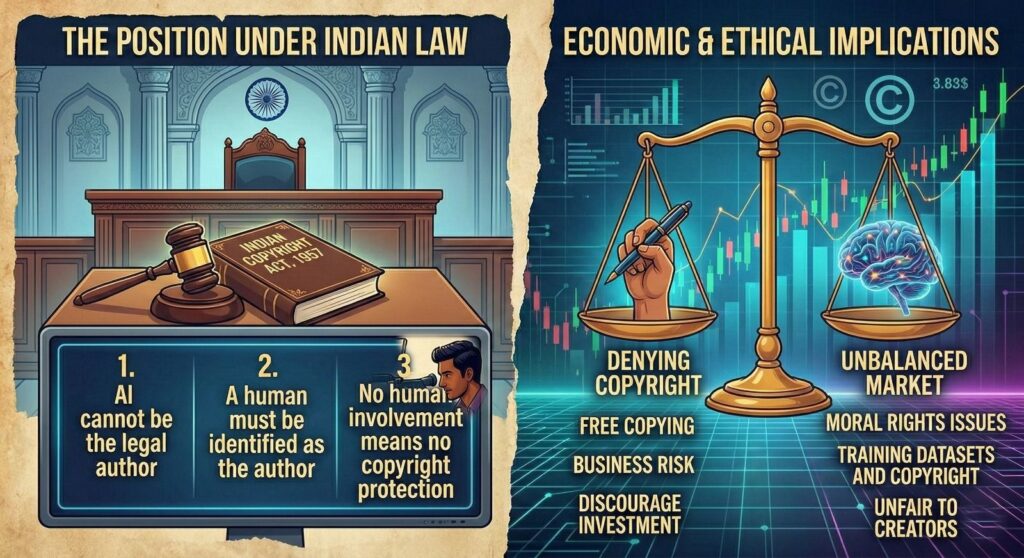
Does India recognize AI as an author? The short answer is no. While there was a brief moment where the Indian Copyright Office granted co-authorship to an AI named RAGHAV, that registration was later withdrawn. The current legal consensus is:
- AI cannot be a legal author or owner.
- A natural (human) person must be identified as the author.
- Works with zero human involvement may be deemed uncopyrightable, meaning they enter the public domain immediately.
5. The Originality Threshold
For a work to be protected in India, it must be “original.” Indian courts require a “modicum of creativity.” If a human merely clicks a “generate” button without exercising creative judgment, the work may fail the originality test, leaving software developers and digital agencies at risk of having their content stolen or copied without recourse.
6. Economic and Ethical Impact
The lack of clarity in AI copyright laws has real-world consequences:
- Investment Risk: Businesses may hesitate to invest in AI content if it can be freely copied by competitors.
- Market Distortion: Allowing corporations to copyright mass-produced AI content could sideline human artists and creators.
- Data Ethics: AI models are trained on existing copyrighted data. If AI outputs are protected while the original creators of the training data are ignored, it creates a massive ethical gap.
7. Global Comparison: UK vs. USA
India is watching how other nations handle this:
- United Kingdom: One of the few countries that protects “computer-generated works,” granting copyright to the person who made the “arrangements necessary for the creation of the work.”
- United States: The US Copyright Office has strictly rejected claims for AI-only works, maintaining that human authorship is a non-negotiable requirement.
8. The Road Ahead: Potential Legal Reforms
To stay competitive, India may need to update the 1957 Act. Future reforms could include:
- Sui Generis Protection: Creating a specific, shorter-term right for AI-generated content.
- Clarifying “Arrangements”: Adopting a UK-style model where the person initiating the AI process owns the rights.
- Training Transparency: Requiring AI developers to disclose and compensate for the use of copyrighted data in training sets.
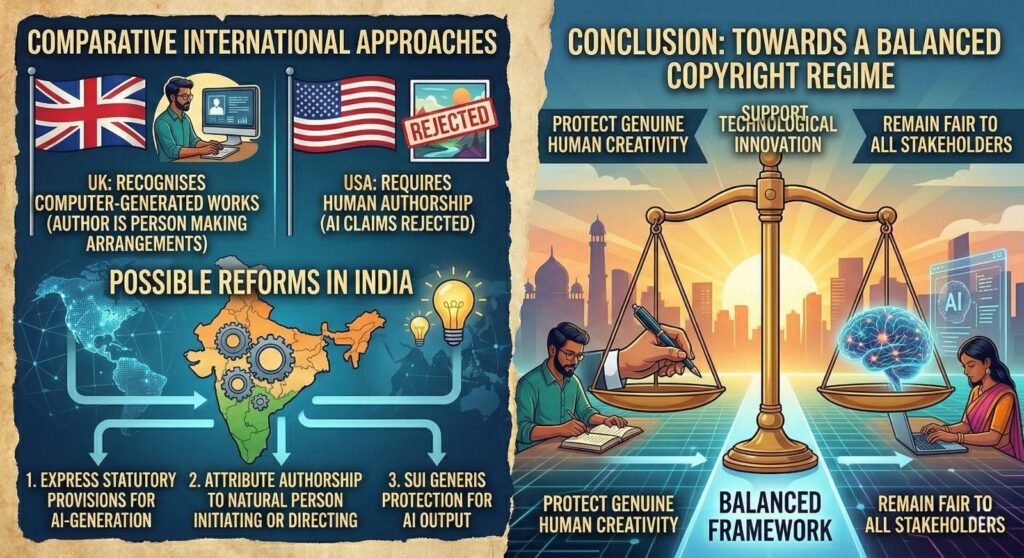
9. Conclusion: Finding a Balanced Framework
AI is redefining the boundaries of creativity, but Indian law remains anchored in human authorship. For now, the best strategy for creators and businesses is to document the human contribution (prompts, edits, and revisions) in any AI-assisted project to strengthen their legal claims.
As India navigates this “moment in history,” the goal must be a regime that protects human spirit while embracing technological progress.