

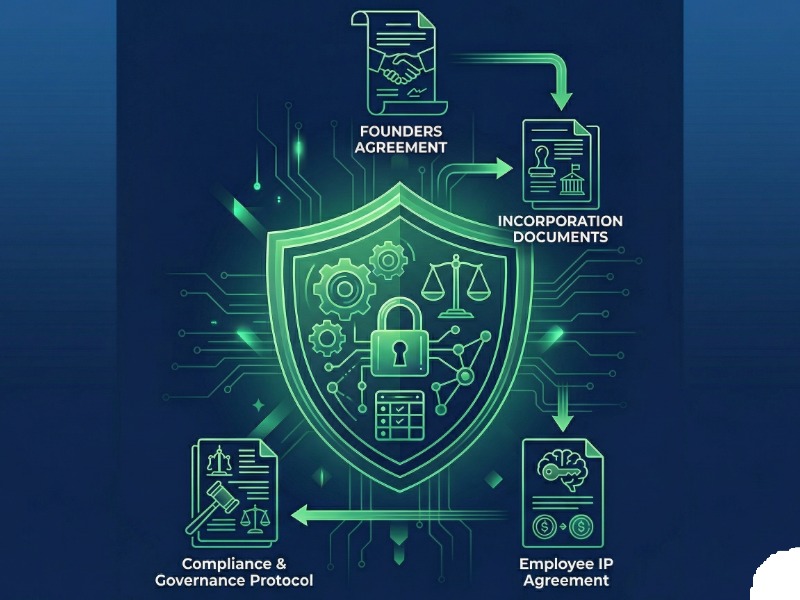
Startup Incorporation
& Legal Advisory

End-to-end startup legal support — DPIIT recognition, compliance management, founder agreements and ESOP implementation — to help you build on a solid legal foundation from day one.

DPIIT Startup Recognition Startup Compliance Founder Agreements ESOP Implementation Startup India Scheme
Startup Incorporation and Legal Services India — Ingenious IP LLP
Startup Legal Advisory and DPIIT Recognition India — Ingenious IP LLP
About This Service

Legal Foundation for Your Startup

Building a startup on a strong legal foundation from the outset prevents costly disputes and compliance issues later. Beyond company registration, startups face a unique set of legal requirements — from obtaining DPIIT recognition to structuring founder equity, managing ongoing statutory compliance and implementing employee incentive schemes.

The Startup India scheme, administered by the Department for Promotion of Industry and Internal Trade (DPIIT), provides recognized startups with access to a range of benefits — including tax exemptions, simplified compliance under select labour and environmental laws, and access to government funding support through designated schemes.

At Ingenious IP LLP, we provide practical, accurate legal support to early-stage and growing startups — covering DPIIT recognition, compliance management, founder agreements and ESOP implementation — so founders can focus on building their business.

What We Offer

Our Startup Legal Services

Comprehensive legal and compliance support designed specifically for the needs of early-stage and growing startups in India.

DPIIT Startup Recognition

We assist startups in obtaining recognition from the Department for Promotion of Industry and Internal Trade (DPIIT) under the Startup India scheme. DPIIT recognition provides access to tax exemptions, funding opportunities and government benefits designed to support the startup ecosystem.

To be eligible, the entity must be incorporated as a Private Limited Company, LLP or Registered Partnership Firm, be no more than 10 years old from incorporation, have annual turnover not exceeding INR 100 crore in any financial year since incorporation, and be working toward innovation or a scalable business model.

DPIIT Scheme Tax Benefits 10-Year Eligibility INR 100 Cr Turnover Limit

Startup Compliance Management

Post-incorporation compliance is crucial for startups to maintain good standing with the MCA and other regulatory authorities. We offer comprehensive compliance management services — including annual return filings, board meeting documentation, statutory register maintenance and other periodic regulatory requirements.

Our compliance management allows founders to focus on business growth rather than administrative obligations, while ensuring the company meets all its statutory duties under the Companies Act 2013 and related rules.

Annual Filings Board Minutes Statutory Registers MCA Compliance

Founder Agreements

Clear agreements among founders prevent disputes and ensure smooth operations. We draft comprehensive founder agreements covering equity distribution, roles and responsibilities, IP ownership, vesting schedules and exit mechanisms — providing a clear legal framework for the founding team from the outset.

A well-structured founder agreement addresses critical questions before they become disputes — including what happens if a founder leaves, who owns IP created before or during the company's operations, and how decisions are made when founders disagree.

Equity Distribution Vesting Schedule IP Ownership Exit Mechanism

ESOP Scheme Implementation

Attract and retain talent with Employee Stock Option Plans (ESOPs). We help design and implement ESOP schemes — including plan documentation, compliance with the Companies Act 2013 and Companies (Share Capital and Debentures) Rules 2014, and guidance on tax implications for employees and the company.

ESOPs allow startups to offer equity participation as part of the compensation package — enabling founders to attract skilled talent without immediate cash outflow, while aligning employee interests with the long-term growth of the company.

ESOP Plan Document Vesting & Exercise Companies Act 2013 Employee Incentive
DPIIT Recognition Benefits

Key Benefits of DPIIT Startup Recognition

DPIIT-recognized startups are eligible for the following benefits under the Startup India scheme — subject to eligibility criteria and applicable conditions for each benefit.

Income Tax Exemption

DPIIT-recognized startups may be eligible for income tax exemption under Section 80IAC of the Income Tax Act for 3 consecutive years out of the first 10 years since incorporation — subject to obtaining an Inter-Ministerial Board (IMB) certificate. Tax benefits are subject to applicable eligibility conditions.

Self-Certification Under Labour Laws

DPIIT-recognized startups can self-certify compliance under certain specified labour and environmental laws for a period of up to 3 to 5 years from the date of incorporation, reducing the compliance burden during the early growth phase — subject to the applicable scheme terms.

Fast-Track Patent & Trademark Processing

DPIIT-recognized startups can avail fast-track examination of patent applications and a rebate of up to 80% on patent filing fees (for startups) and a rebate on trademark filing fees — subject to the applicable scheme and fee structure at the time of filing.

Fund of Funds Access

DPIIT-recognized startups may be eligible to access government-backed funding through the Fund of Funds for Startups (FFS), managed by SIDBI — which invests in SEBI-registered Alternative Investment Funds (AIFs) that in turn provide funding to eligible startups.

Easier Winding Up

DPIIT-recognized startups may be eligible for faster and simpler winding-up procedures under the Insolvency and Bankruptcy Code — in contrast to the typically longer winding-up process for regular companies.

Government Procurement & Tenders

DPIIT-recognized startups may be given relaxed eligibility criteria in government procurement processes — including exemptions from prior experience requirements, turnover requirements and earnest money deposits in certain public tenders — subject to applicable policy terms.

Ongoing Compliance

Startup Compliance Obligations

Post-incorporation compliance is an ongoing obligation for all registered companies in India. The following are key annual and periodic compliance requirements for startups.

Annual ROC Filings

All registered companies must file annual returns and financial statements with the Registrar of Companies (ROC) through the MCA portal — including Form AOC-4 (financial statements) and Form MGT-7 (annual return) within the prescribed time limits after the Annual General Meeting (AGM).

Board Meetings & Minutes

Every company must hold a minimum number of Board Meetings in a year — with a minimum of 4 board meetings in a calendar year for private limited companies, with not more than 120 days between two consecutive meetings. Proper minutes of all board and general meetings must be prepared and maintained in the minute book.

Statutory Register Maintenance

Companies must maintain several statutory registers under the Companies Act 2013 — including the Register of Members, Register of Directors and Key Managerial Personnel, Register of Charges and Register of Contracts — and keep them updated at the registered office at all times.

Common Questions

Startup Incorporation FAQ

Accurate answers to frequently asked questions about startup incorporation, DPIIT recognition and founder agreements in India.

DPIIT startup recognition is official recognition granted by the Department for Promotion of Industry and Internal Trade under the Startup India scheme. To be eligible, the entity must be incorporated as a Private Limited Company, LLP or Registered Partnership Firm; be no more than 10 years old from the date of incorporation; have annual turnover not exceeding INR 100 crore in any financial year since incorporation; and be working toward innovation, development of products or services, or operating a scalable business model with potential for employment generation or wealth creation.

DPIIT-recognized startups may be eligible for income tax exemption under Section 80IAC of the Income Tax Act for 3 consecutive assessment years out of the first 10 years since incorporation — subject to meeting the applicable eligibility conditions and obtaining approval from the Inter-Ministerial Board (IMB). Tax benefits and their exact terms are governed by the applicable provisions of the Income Tax Act and associated notifications — it is advisable to verify current eligibility conditions at the time of application.

A founder agreement is a legally binding contract between co-founders that governs their relationship, rights and obligations with respect to the company. It typically covers equity distribution, roles and responsibilities, IP ownership, vesting schedules, confidentiality obligations and exit or buyout mechanisms.

Without a founder agreement, disputes over equity, IP ownership or roles can be difficult and costly to resolve. A well-drafted founder agreement addresses these issues proactively — providing a clear legal framework before any disagreements arise.

An Employee Stock Option Plan (ESOP) gives employees the right to purchase shares of the company at a predetermined price after completing a specified vesting period. In India, ESOPs for private limited companies are governed by the Companies Act 2013 and the Companies (Share Capital and Debentures) Rules 2014. Implementation requires a board-approved ESOP plan document specifying the total number of options to be granted, exercise price, vesting conditions and lock-in periods.

A vesting schedule specifies the timeline and conditions under which a founder's equity or an employee's stock options become fully owned or exercisable. A common structure used in early-stage startups is a 4-year vesting schedule with a 1-year cliff — meaning no equity vests during the first year, after which 25% vests at the end of year one and the remainder vests gradually over the following 3 years.

Vesting schedules protect the company and remaining stakeholders if a founder or employee leaves before contributing the expected value — ensuring equity is earned over time through continued commitment rather than granted immediately at incorporation.

Why Ingenious IP LLP

Why Choose Our Startup Services

We combine IP expertise with practical startup legal advisory to provide founders with reliable, accurate and commercially grounded support from incorporation through growth.

DPIIT Recognition Advisory & Filing

Experienced Founder Agreement Drafting

ESOP Plan Design & Implementation

End-to-End Compliance Management

Transparent & Honest Startup Advisory

IP + Startup Under One Roof

Accurate, Up-to-Date Legal Advisory

Focused on Founder & Startup Needs

Ready to Build Your Startup Right?

Speak with our startup legal team for DPIIT recognition, founder agreements, ESOP implementation and compliance support — built for founders, by IP and legal professionals.