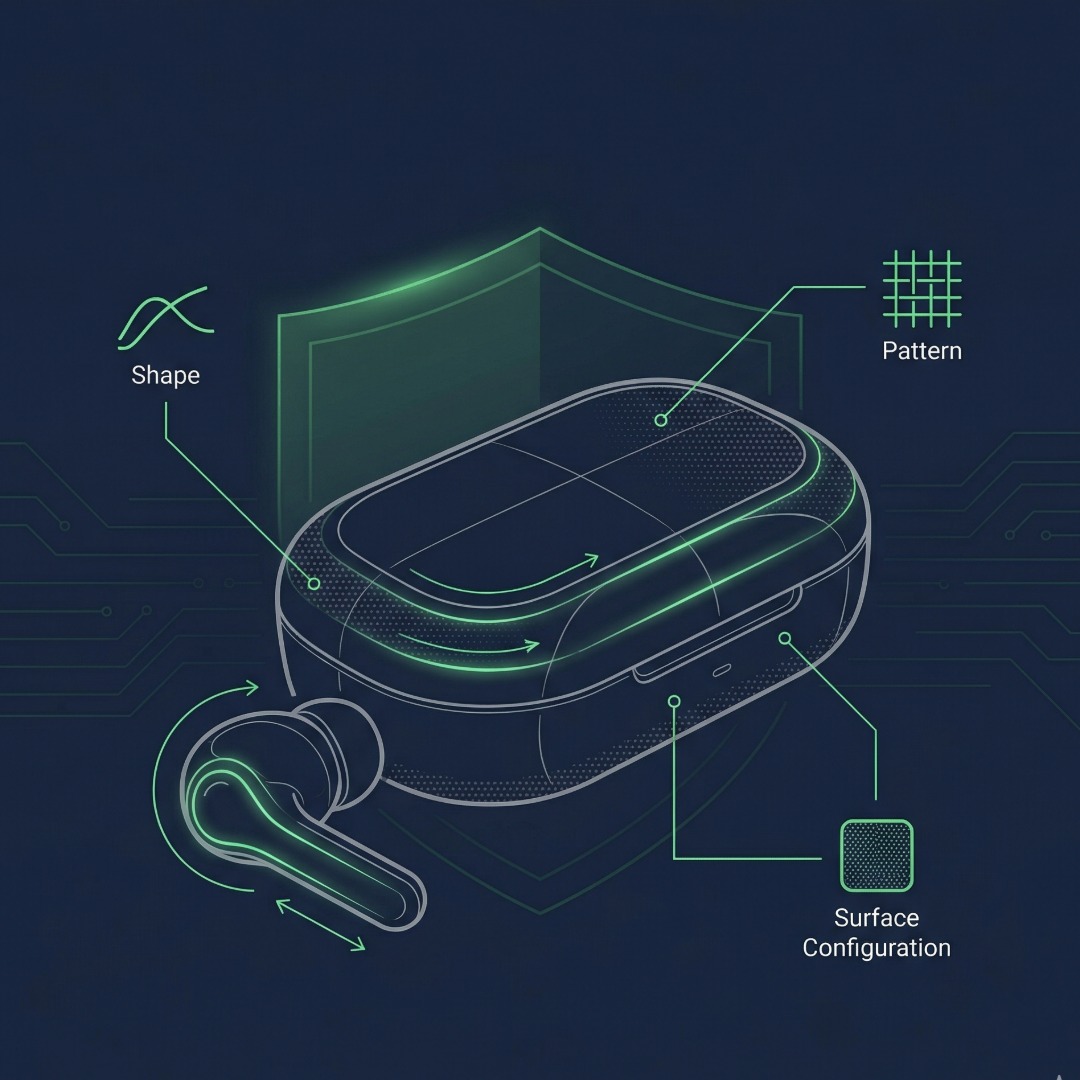
Under the Designs Act 2000, a “design” means only the features of shape, configuration, pattern, ornament or composition of lines or colours applied to any article — whether in two dimensional or three dimensional or in both forms, by any industrial process or means, whether manual, mechanical or chemical, separate or combined — which in the finished article appeal to and are judged solely by the eye.
Design registration gives the registered proprietor the exclusive right to apply the registered design to the article in the class in which it is registered — and the right to seek injunctive relief and damages against any person who applies an identical or fraudulently imitative design without authorisation. The law applicable to designs in India is the Designs Act 2000, which replaced the earlier Designs Act 1911.
In addition to design registration, we provide USPTO, EPO and Indian Patent Office-compliant patent illustration services — creating precise diagrams, 3D models and technical schematics that meet the formal drawing requirements of major patent offices. Clear and compliant patent illustrations strengthen patent applications and help minimize procedural objections and delays.
Design Services
Industrial Design Registration & Litigation
We provide comprehensive industrial design services — from initial filing and prosecution through enforcement and litigation support under the Designs Act 2000.
Design Filing
Industrial design is the application of a combination of applied art and science to improve the aesthetics, ergonomics and usability of a product. An industrial design consists of the creation of a shape, configuration or composition of pattern or colour — or a combination of pattern and colour — in a two or three dimensional form having aesthetic value.
We assist with design registration with the Design Registry, India — preparing and filing the application accurately, responding to office actions, attending hearings, managing renewals, and handling opposition proceedings to ensure your design rights are established and maintained.
Design Registry IndiaApplication Preparation2D & 3D DesignsOffice Action Response
Design Prosecution
Industrial designs under the Designs Act 2000 means only the features of shape, configuration, pattern, ornament or arrangement of lines or colours applied to any article — whether in two or three dimensional form — which in the finished article appeal to and are judged solely by the eye. Design registration does not extend to any mode or principle of construction, or to any trademark.
The property in a registered design consists in the exclusive right to apply the registered design to any article in the class in which it is registered. We manage the complete prosecution process — including examination responses, objection replies, hearings before the Controller of Designs and amendment of applications.
Design registration gives the registered proprietor the exclusive right to make, sell and use articles that embody the protected design — to the exclusion of all others. Registration is essential to ensure and enforce design rights. Under the Designs Act 2000, a registered design is initially valid for 10 years from the date of registration and can be renewed for a further 5 years — giving a maximum protection period of 15 years.
10+5 Year ProtectionExclusive Use RightDesigns Act 2000Renewal Management
Design Litigation
Piracy of a registered design means the application of a design identical to or fraudulently or obviously imitative of the registered design to any article in the same class without the licence of the registered proprietor. If the registered proprietor believes that piracy of the registered design has occurred, the registered proprietor can file a suit for injunction and/or damages before the District Court having competent jurisdiction.
We provide structured design litigation support — including infringement assessment, preparation of evidence and coordination with litigation counsel for proceedings before District Courts having competent jurisdiction under the Designs Act 2000.
Infringement AssessmentSuit for InjunctionDamages ClaimDistrict Court Proceedings
Design Search
Before filing a design application, we conduct a design search on the Design Registry database to identify identical or similar registered designs in the same class. A design search helps assess the likelihood of registration and the risk of conflict with existing design rights — supporting an informed filing decision before investing in design protection.
For businesses seeking design protection in multiple countries, we assist with international design registration — including filings under the Hague System for the International Registration of Industrial Designs administered by WIPO, which allows a single international application to seek protection in multiple member countries. We also assist with direct national design filings in other jurisdictions.
Hague System (WIPO)International FilingMulti-Country ProtectionNational Design Filings
Precise, accurate and office-compliant patent diagrams, 3D models and technical schematics that enhance patent applications and minimize procedural objections at major patent offices.
USPTO-Compliant Patent Drawings
Patent drawings prepared in strict conformity with 37 CFR 1.84 — the USPTO rules for patent drawings. Requirements include black ink on white paper, specific line quality, shading conventions, reference numeral placement, correct margins and drawing size. Compliant illustrations help avoid formal objections from the USPTO that can delay prosecution.
EPO-Compliant Patent Illustrations
Patent drawings prepared in conformity with Rule 46 of the European Patent Convention (EPC) — which specifies requirements for drawings accompanying European patent applications, including drawing format, execution standards, reference signs and the relationship between drawings and the description. Accurate EPO drawings support smooth prosecution before the European Patent Office.
Indian Patent Office Drawings
Patent drawings prepared in conformity with the Patent Rules 2003 applicable to the Indian Patent Office — specifying requirements including drawing size (A4), use of black, durable, permanent and dense lines, correct labelling of figures and consistent use of reference numerals across all drawings and the description. IPO-compliant drawings avoid formal objections during examination.
PCT International Patent Drawings
Patent drawings prepared in conformity with PCT Rule 11 — the PCT regulations governing drawings for international patent applications filed under the Patent Cooperation Treaty. PCT-compliant drawings are prepared to satisfy the requirements of the receiving office and the designated offices of target countries simultaneously.
3D Models & Technical Diagrams
Creation of precise 3D models and technical schematics that clearly define an invention’s structure, components and spatial relationships — enhancing the patent specification’s clarity and enabling a skilled person in the art to understand and reproduce the invention. 3D illustrations are particularly valuable for mechanical, electrical and product design inventions.
Flowcharts & Process Diagrams
Structured flowcharts and process diagrams illustrating method claims and process steps — particularly important for software, algorithm, business method and process-based patent applications. Clear process diagrams support both the written description and the claims by visually mapping the steps and decision points of the patented method.
Registration Process
Design Registration Process in India
A clear overview of the industrial design registration process with the Design Registry in India under the Designs Act 2000.
1
Design Search & Novelty Assessment
Before filing, we conduct a search on the Design Registry database to identify existing registered designs in the same class. The Designs Act 2000 requires that a design must be new or original — not previously published or registered in India or elsewhere before the date of application — to be registrable. The search helps assess the registrability and inform the filing strategy.
2
Application Preparation & Drawing
We prepare the design registration application — including the prescribed Form 1 or Form 2, accurate representations or specimens of the design (photographs or drawings showing the article from all relevant views), classification of the article under the applicable Locarno Classification, and a statement of novelty. Accurate representations are critical — the scope of design protection is defined by the representations filed.
3
Filing with the Design Registry
The application is filed with the Design Registry at the Patent Office, Kolkata — which is the designated office for design registrations in India. Design applications may be filed online or in person. On filing, the Design Registry issues an application number and the application undergoes formal examination before substantive examination.
4
Examination & Office Action Response
The Design Registry examines the application for compliance with the requirements of the Designs Act 2000 and Designs Rules 2001 — including novelty, registrability and formal requirements. Where objections are raised, we prepare and file detailed replies addressing each ground of objection and, where necessary, attend hearings before the Controller of Designs.
5
Registration & Certificate
Upon satisfactory examination, the Controller registers the design and a Design Registration Certificate is issued. The registration is initially valid for 10 years from the date of registration. We track renewal deadlines and manage timely filing of the renewal application (within 10 years of registration) to extend protection for the further 5-year period — for a total maximum protection of 15 years.
Formal Drawing Standards
Patent Office Drawing Requirements
Patent illustrations must comply with the formal drawing requirements of the target patent office. Non-compliant drawings generate formal objections that delay prosecution. We prepare drawings that meet the following standards.
USPTO — 37 CFR 1.84
USPTO patent drawings must use black permanent ink on white paper, meet specific margin requirements, use standardized shading conventions, include reference numerals consistent with the specification and conform to size requirements. Drawings may be in black and white or colour (colour drawings require a petition and fee). Non-compliant drawings result in a Notice of Informal Application.
EPO — Rule 46 EPC
EPO drawings must be on A4 sheets with specific usable surface dimensions, use durable black lines, have consistent reference signs throughout the application, and comply with EPO standards for cross-sectional views, exploded views and sequence of figures. Drawings must not contain text other than single words where necessary.
Indian Patent Office — Patent Rules 2003
IPO drawings must be on A4 size sheets, use black, durable, permanent and dense lines and strokes, have adequate margins, include figure numbers for each drawing, use reference numerals consistently with the complete specification and be executed so that they can be directly reproduced. Coloured drawings are generally not accepted.
PCT — PCT Rule 11
PCT patent drawings must comply with PCT Rule 11 — specifying requirements for drawing sheets, lines, hatching, reference signs, figure identification and the relationship between drawings and the description. PCT drawings must be prepared to satisfy all designated offices of target countries simultaneously wherever possible.
Design Registry — Designs Rules 2001
Design representations filed with the Indian Design Registry must be photographs or drawings of the article from all relevant views — typically front, back, left, right, top and bottom views — clearly showing the features of the design. Representations must be of adequate quality to clearly identify the visual features of the design for which protection is sought.
Illustration Benefits
High-quality, compliant patent illustrations enhance the patent specification by clearly defining the invention — making it easier for patent examiners, courts and third parties to understand the scope of the claims. Clear illustrations reduce the risk of misunderstanding and support more effective enforcement of granted patent rights.
Illustration Tools
Professional Tools & Technology We Use
Our patent illustration team uses industry-standard software tools to create precise, accurate and office-compliant patent drawings and design representations.
Accurate answers to frequently asked questions about design registration, patent illustrations and related services in India.
Industrial design registration in India is governed by the Designs Act 2000. A design means only the features of shape, configuration, pattern, ornament or composition of lines or colours applied to any article — whether in two or three dimensional form — which in the finished article appeal to and are judged solely by the eye. Design registration gives the registered proprietor the exclusive right to apply the registered design to the article in the class in which it is registered for the term of protection.
Under the Designs Act 2000, a registered design is initially valid for 10 years from the date of registration. It can be renewed for a further period of 5 years — giving a maximum total protection period of 15 years. The renewal application must be filed before the expiry of the initial 10-year period. After the maximum 15-year term, the design enters the public domain and can no longer be protected under the Designs Act.
Under the Designs Act 2000, piracy of a registered design means applying a design identical to or fraudulently or obviously imitative of the registered design to any article in the same class as the registered design — without the licence of the registered proprietor. If the registered proprietor believes design piracy has occurred, they can file a suit for injunction and/or damages before the District Court having competent jurisdiction in the matter.
Under the Patent Rules 2003, every application for a patent must be accompanied by drawings wherever the nature of the invention admits. Where drawings are necessary to understand the invention, they must be filed with the application or before the expiry of the prescribed period. Drawings must conform to the formal requirements specified in the Patent Rules 2003 — including size (A4), line quality, margins and reference numeral conventions. Non-compliant drawings will attract a formal objection from the Indian Patent Office.
Design registration under the Designs Act 2000 protects the visual appearance of an article — its shape, configuration, pattern, ornament or composition of lines or colours as applied to a product. It does not protect any principle or mode of construction. Protection lasts up to 15 years.
Patent protection under the Patents Act 1970 protects the functional invention — the technical solution to a technical problem. It protects how an invention works, is made or is used — not just how it looks. Protection lasts 20 years from the filing date. A product may be eligible for both design registration and patent protection simultaneously if both the visual appearance and the functional aspects are novel and protectable.
Why Ingenious IP LLP
Why Choose Our Design & Illustration Services
We combine registered IP professional expertise with technical illustration capabilities to deliver accurate, compliant and commercially effective design and patent illustration services.
Designs Act 2000 — Registered IP Professionals
USPTO, EPO & IPO Compliant Illustrations
PCT & Hague System International Filings
3D Models, Diagrams & Technical Schematics
Transparent & Honest Advisory
Design Infringement & Litigation Support
WIPO-Certified IP Professionals
Timely Delivery & Deadline-Driven Service
Get Expert Help
Ready to Register Your Design or Get Patent Illustrations?
Speak with our IP professionals to register your industrial design, create USPTO or IPO-compliant patent drawings or take enforcement action against design piracy.